Pipeline that mirrors your process
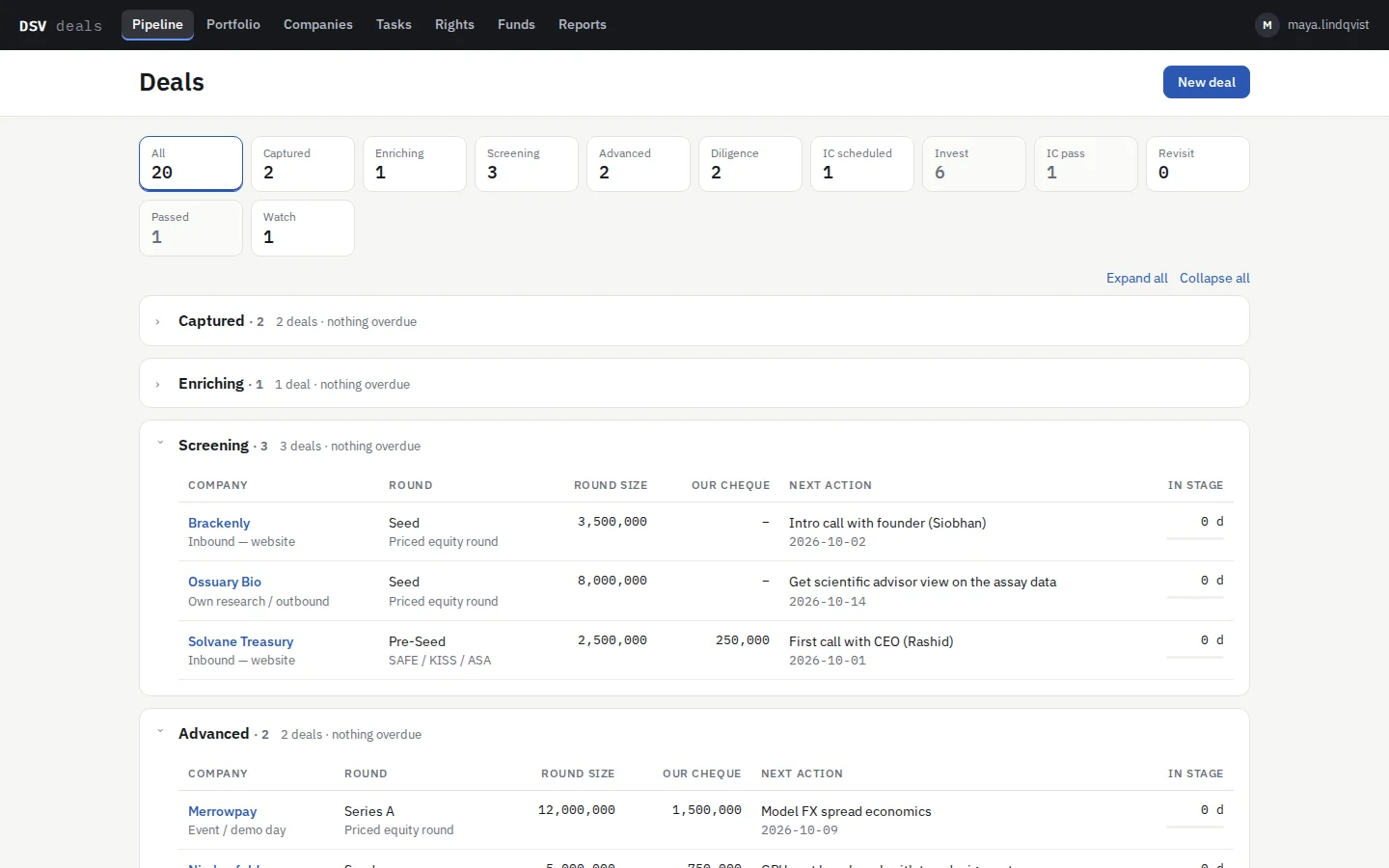
Companies, people and deals, with stage history, notes and a next action that keeps its own history. Links in notes are clickable. Stages are your vocabulary, not ours.
For venture funds that outgrew the spreadsheet
VC Dealflow is a light CRM for deal flow and an append-only ledger for everything you own after the wire goes out. Cost, NAV, fully-diluted ownership and MOIC are always derived, never typed, and every change carries a name. An assistant beside every deal does the legwork; you stay the one who signs off.
Built by a fund, for the way funds actually work. Nothing you don't need.
Companies, people and deals, with stage history, notes and a next action that keeps its own history. Links in notes are clickable. Stages are your vocabulary, not ours.
When a deal closes it becomes a holding: fund × company, with lifecycle, health rating, board seat and pro-rata rights. A follow-on round joins the holding the fund already has.
What happened at the company, what the fund booked, and the per-security legs. Corrections are reversals, never edits.
Instruments with their conditions, conversions at the next round, splits and cap-table checkpoints, all with FD % by component.
IPEV-style valuation marks in local currency with an FX snapshot. MOIC and NAV in USD are computed, so they can't drift.
Major-investor thresholds, information and pro-rata rights, read out of the actual documents and flagged when they need a look.
Portfolio, fund summary, pipeline, ledger and data-quality exceptions. HTML, CSV or JSON, filtered by fund and date.
Every table is audited and every write records who made it. Sign in with Google; access by email or domain.
Load your existing sheet once, with cleansing maps you can review, and a reconciliation that fails loudly on any variance.
Let your own research or sourcing agent read the pipeline and add deals, companies and notes, through scoped, revocable tokens. Agent-written entries are marked as such.
Share selected deals with co-investors on their own site, with commentary you write, never your thesis. Links bind to one verified email, and partners ask for more right from the deal page.
Pitches and forwards to your deal groups land in a review queue, summarised and matched to the companies you know. Open a deal, attach it or dismiss it. Your rules filter the noise, and a daily digest lists what came in.
A side panel on every deal and company page that follows what you're looking at. It reads; you decide.
A one-page summary of the record and your research, rebuilt when it goes stale and ready when you open the page.
Ask about a company, its history or its terms. Get questions for the next call and follow-ups for after it.
It suggests a note, a next action, a stage move or a deal update as a card. You apply it, under your own name, through the same checks as any change.
It writes the email; the draft lands in your own inbox to edit and send. Nothing goes out in your name without you.
Point it at your research repository on GitHub or Forgejo. The team reads it in the app, and longer research goes to your own research agent over A2A.
Talks to the model provider directly, with no vendor SDK in between, so adding another provider is a small adapter. Token use is recorded per call. Works on a phone, too.
Screens from the product. The companies, funds and people shown are imaginary.
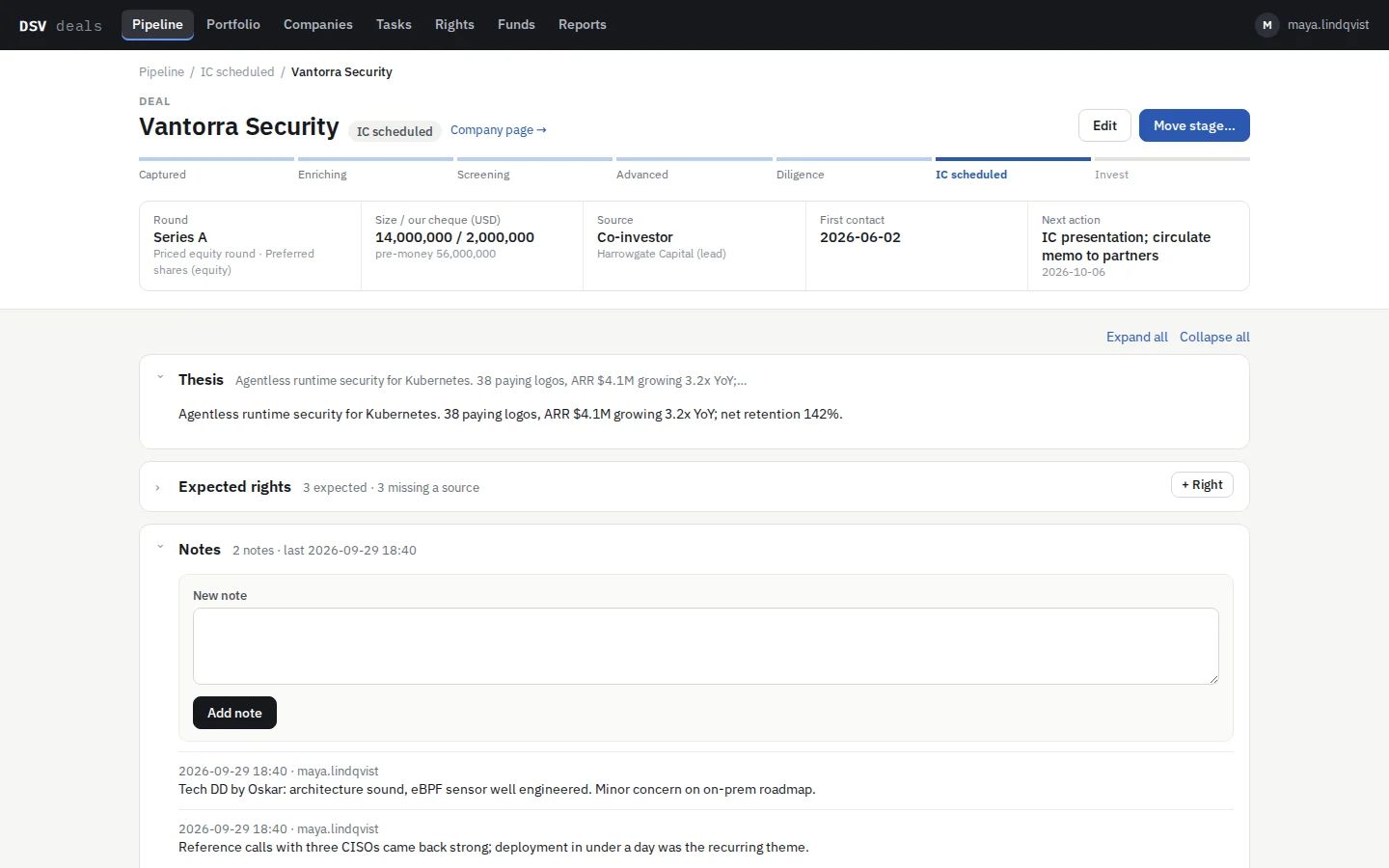
01 · Deal
Stage, round terms, the next action and a journal of notes, with the full stage history underneath. Move it forward in one click; hand it off to a fund at invest.
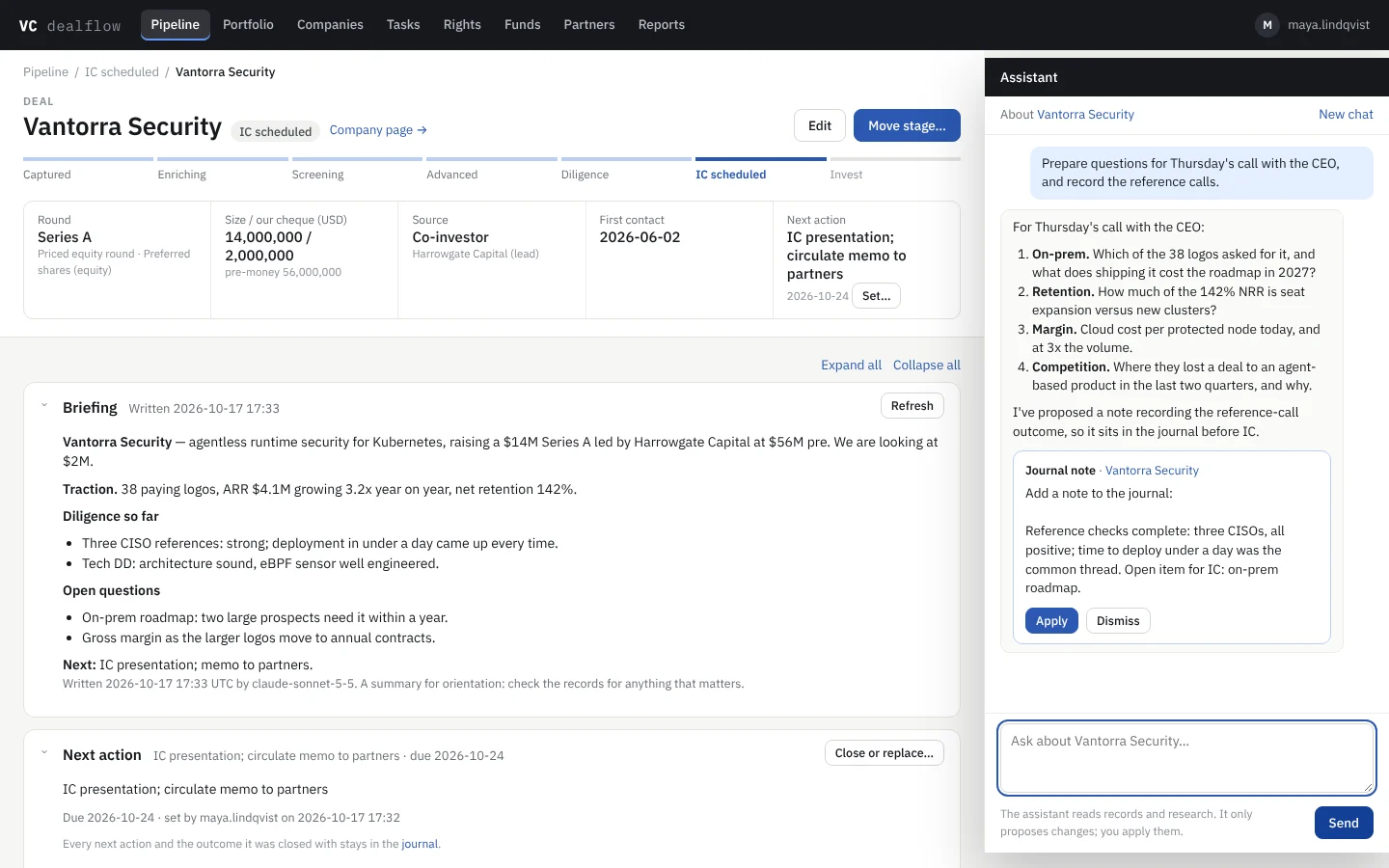
02 · Assistant
A briefing on the company is waiting when you open the deal. Ask for call prep and get questions grounded in the record; the note it suggests sits there as a card until you apply it.
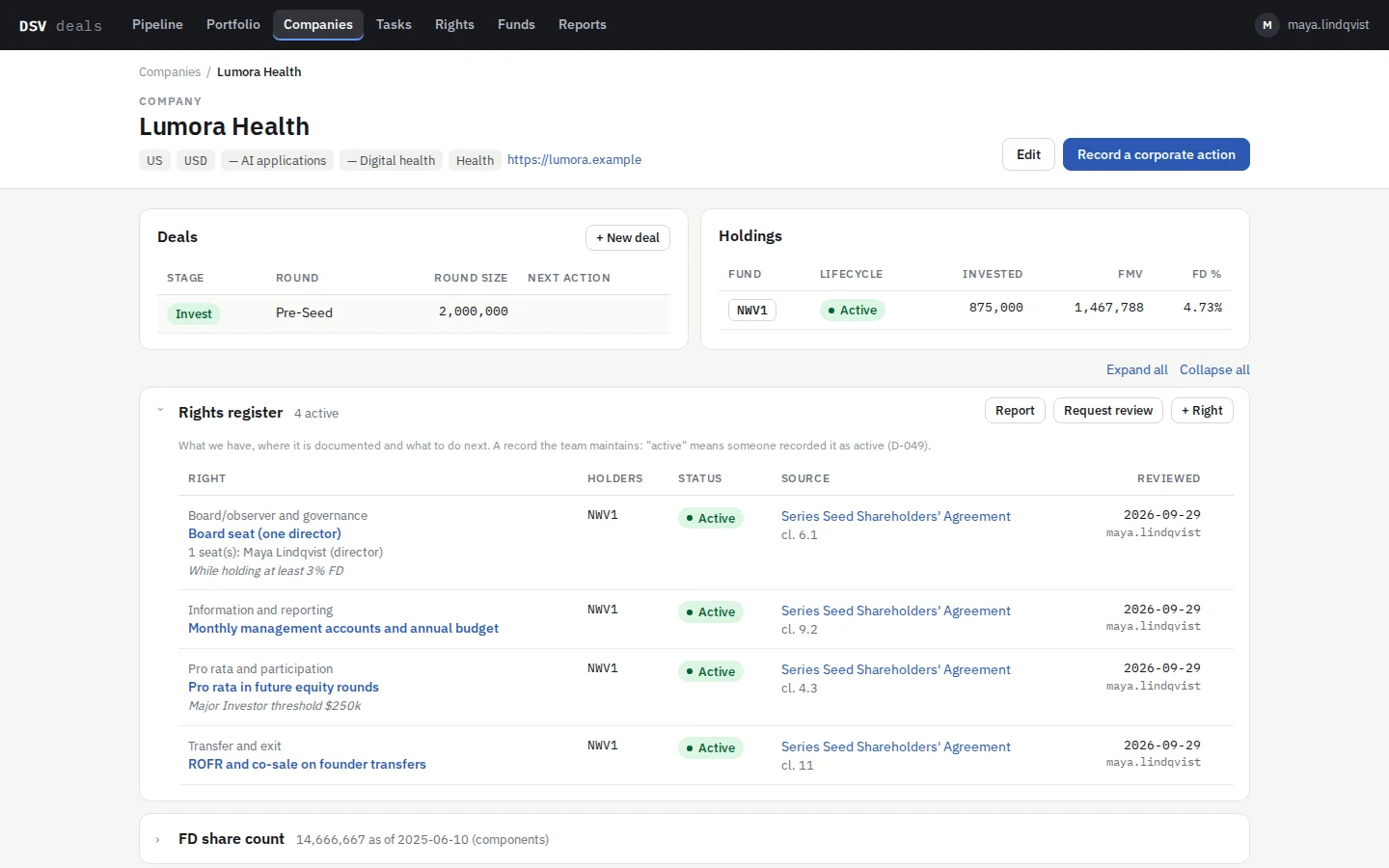
03 · Company
Legal entities through flips and renames, every instrument you hold, and the rounds, splits and conversions that shaped the cap table.
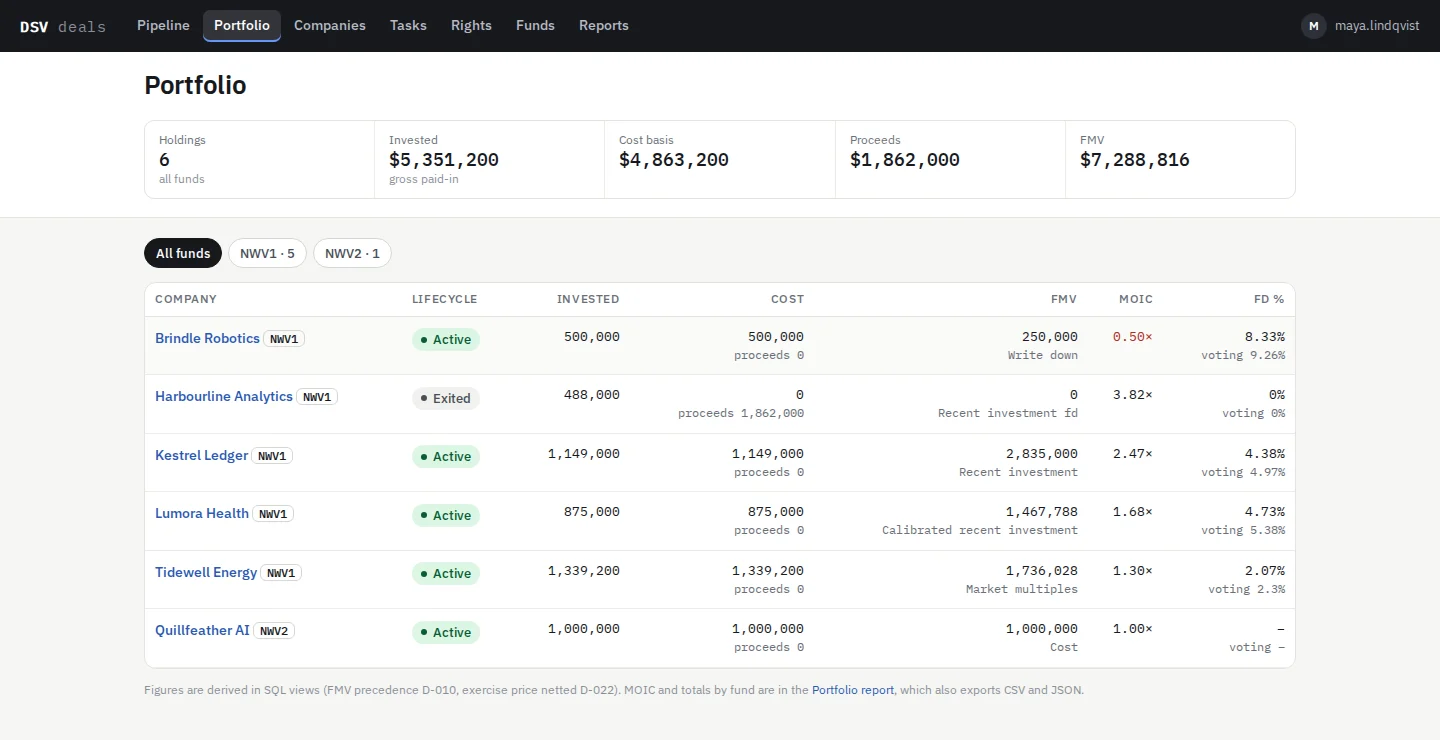
04 · Portfolio
Cost, latest mark, MOIC and fully-diluted ownership per holding, with lifecycle and health side by side.
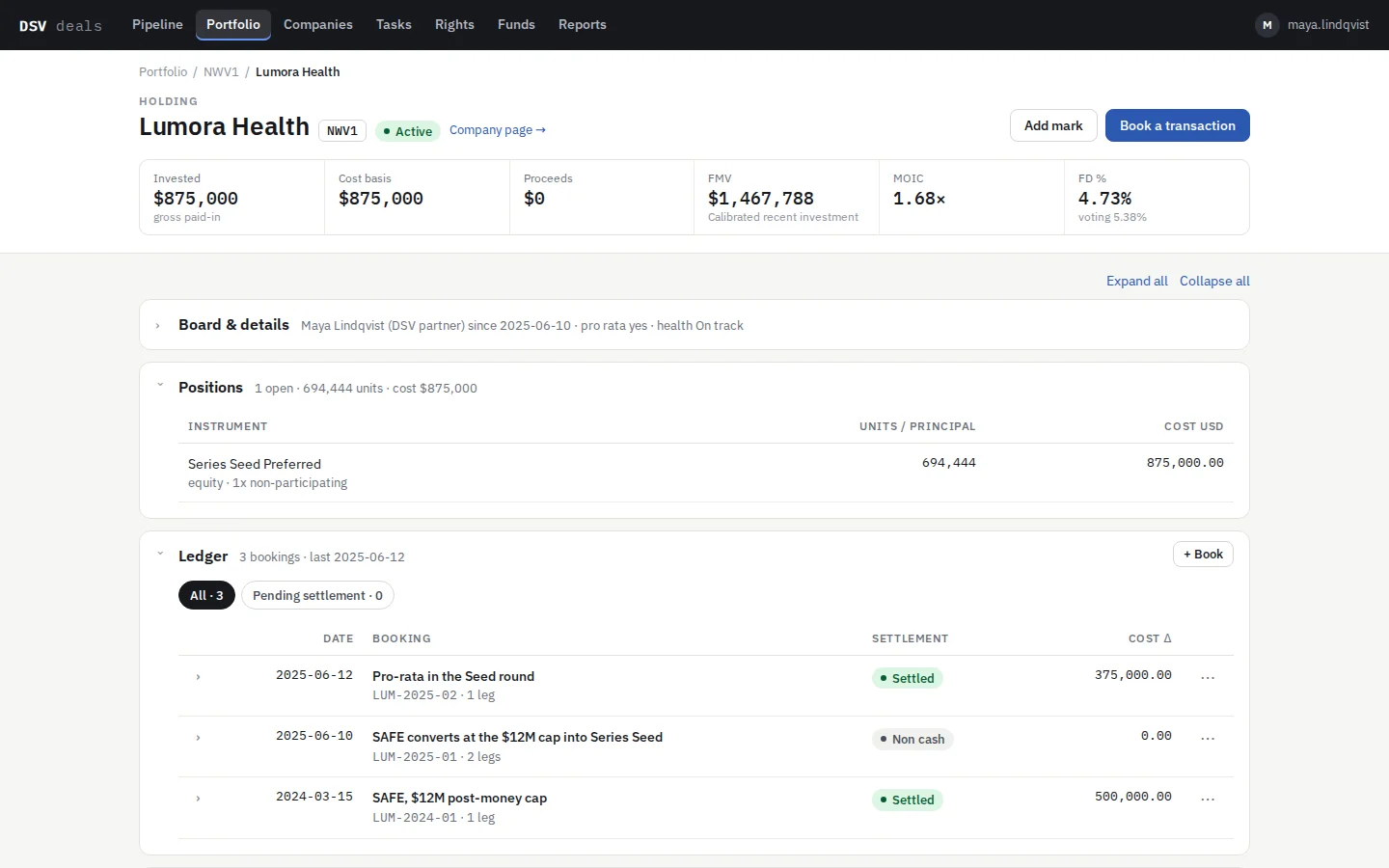
05 · Holding
Positions per security and every booking that made them: a SAFE converting at its cap into the priced round, then a pro-rata top-up. Reversals, never edits.
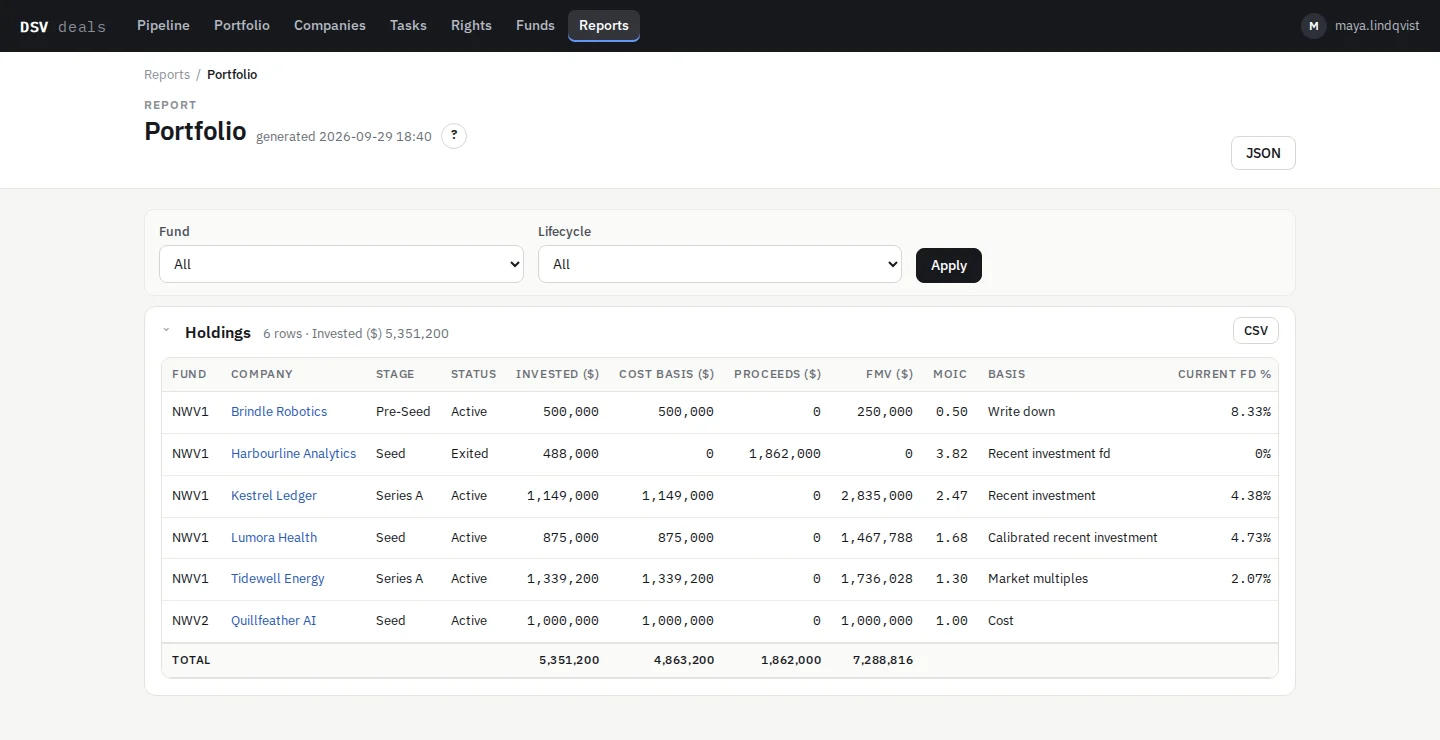
06 · Reports
Fund summaries and ledgers straight from SQL views. Export to CSV or JSON; amounts stay exact decimals end to end.
A deal flow CRM and portfolio management tool for venture capital funds, syndicates and family offices. It tracks companies, people and deals through your pipeline, then keeps an append-only ledger of everything the fund owns once it invests: rounds, SAFEs and convertible notes, valuation marks and fully-diluted ownership.
A general CRM stops at the closed deal, and a spreadsheet drifts as soon as two people edit it. Here a closed deal hands off to the ledger, and cost, NAV, FD % and MOIC are computed from it, never typed. Corrections are reversals, and every change records who made it.
Yes. Instruments keep their cap, discount and conditions, convert into the priced round, and show up in fully-diluted ownership by component. Splits, renames and holding-company flips are corporate actions on the company's record.
On your own server. It runs as Go binaries with PostgreSQL in Docker, and this website shares nothing with it. Partners see only the deals you publish to the showcase, through links bound to their email.
No. It reads the records and your research, writes briefings and call prep, and proposes notes, next actions or stage moves as cards. Nothing is written until a person applies a card, under their own name. It works with Anthropic, OpenAI and other providers, and only the ones you approve ever see deal data.
Yes, through the MCP endpoint. Each agent gets its own revocable token with scopes, it can read the pipeline and add deals, companies and notes, and everything it writes is marked as agent-written.
Yes, read-only. A mailbox that belongs to your deal groups is signed in once, and only mail sent to those groups is ever downloaded. Each thread becomes a proposal in a queue: a person opens the deal, attaches it to one you have, or dismisses it. Rules you control drop newsletters and the like, and filtered mail stays visible.
The importer loads your existing sheet once, with cleansing maps kept as CSV files you can review, and a reconciliation that refuses to finish while any total disagrees with the source.
Tell us a little about your fund and we'll get back to you with a walkthrough and what it takes to move off your spreadsheet.